
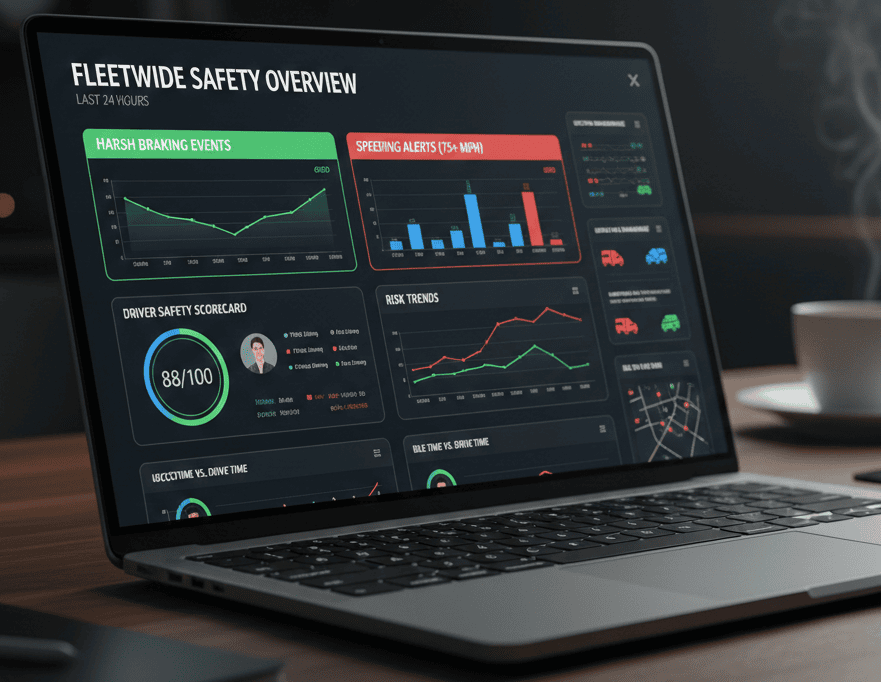
If I mention “telematics” to a room full of drivers, I get groans. They call it “Big Brother.” They think it’s just management trying to spy on them or catch them slipping up.
But if I mention telematics to a room full of fleet owners, the reaction is usually different. It’s fear.
Why? Because many of you have these expensive systems installed, but you aren’t actually using them. You have gigabytes of data sitting on a server somewhere showing that Driver A was speeding and Driver B slammed on his brakes five times yesterday. And you did nothing about it.
Here is the hard truth: In a lawsuit, data you ignored is worse than having no data at all.
If you want your telematics to lower your insurance premiums instead of hanging you in court, you have to change how you use the system. Here is Protocol 2 of the Underwriter’s Checklist.
1. The “Ostrich Strategy” Will Bankrupt You
The biggest mistake I see fleets make is installing cameras and GPS tracking to get an insurance discount, and then ignoring the alerts.
Imagine a driver gets into a serious accident. The plaintiff’s attorney subpoenas your telematics data. They find out that this driver has had 50 “hard braking” and “speeding” alerts in the last three months.
Then they ask you: “Mr. Fleet Owner, you had this data. You knew he was driving dangerously. Why didn’t you stop him?”
If your answer is “I didn’t check the dashboard,” you have just admitted to negligence. You handed them a massive settlement on a silver platter.
The Fix: You cannot collect data you aren’t willing to review. If you turn the system on, you must have a routine—whether it’s daily or weekly—to review the critical alerts. You can’t bury your head in the sand.
2. Stop Punishing and Start Coaching
Underwriters don’t expect your drivers to be robots. They know people make mistakes. What they hate is unaddressed patterns.
Old school fleet management was simple: If a driver screws up, write them up. If they do it again, fire them.
But in this labor market? You can’t afford to fire decent drivers over minor bad habits. You need to fix them.
Use your telematics data to create a coaching culture, not a punishment culture.
-
The Pattern: If the data shows a driver is constantly cornering too hard, sit them down. Show them the clip or the log.
-
The Conversation: “Hey, this behavior leads to rollovers. How do we fix this?”
-
The Documentation: This is the part that saves your renewal. Log that conversation.
When I can show an underwriter, “Look, this driver had bad scores in January, we coached him, and his scores were perfect in March,” that is gold. It proves you are actively reducing risk.
3. Let the Data Fight Your Battles
It’s not all doom and gloom. Telematics is also the only thing standing between you and a fraudulent claim.
We live in the era of “Nuclear Verdicts,” where juries hand out $10 million awards like candy. Without data, an accident is just your driver’s word against theirs. And juries rarely trust the truck driver.
But data doesn’t lie.
-
Did the other car cut into the lane? The camera proves it.
-
Was your driver actually going 5 mph under the limit, not speeding? The GPS proves it.
-
Did they brake immediately? The sensors prove it.
I have seen claims that would have been total losses get closed with $0 paid out because the telematics data exonerated the driver on day one. That keeps your loss ratio clean and your premiums stable.
The Bottom Line
You are paying for the technology anyway. You might as well let it pay you back.
If your telematics dashboard is just a bunch of red notifications that nobody clicks on, you are sitting on a ticking time bomb. But if you use that data to coach your drivers and defend your fleet, it’s the most powerful tool you have to negotiate a better rate.
Not sure if your safety scores are good enough to impress an underwriter? Let’s take a look at your reports together.


